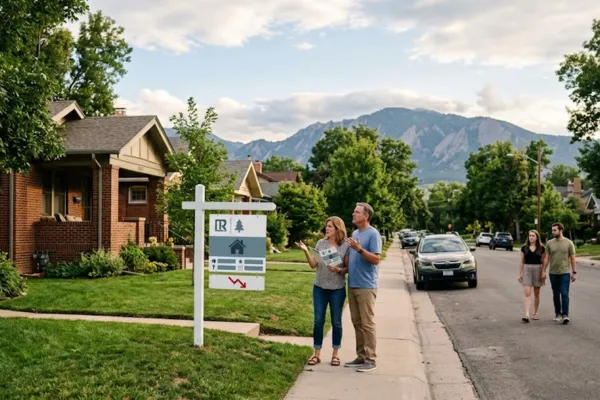
Denver-Area Home Sales Fell Nearly 19% in August. Here Is What It Means for Sellers and Buyers
In this guide, we break down the August numbers in plain English, explain why detached homes and condos are behaving so differently, look at what is happening at the luxury end of the market, and share practical steps for sellers and buyers. You will find answers to common questions at the end.
The August Numbers at a Glance
According to ColoradoBiz's coverage of the DMAR report released September 3, closed home sales across the Denver metro area fell 18.99% from July and 17.35% from August of last year. Monthly sales volume fell 19.45%. Through August, closings were down 3.49% compared with the same period in 2025, so the August drop was larger than the year-to-date trend.
Prices, on the other hand, barely moved. The median closing price was $594,495 in August. That is down 1.74% from July and nearly unchanged from a year earlier. The year-to-date median price was $599,990, up just 0.17%.
Homes also took a little longer to sell than in July, but not longer than last year. The median time in the multiple listing service was 27 days, up from 21 days in July and below the 30 days recorded in August 2025.
Inventory was flat too. Active listings totaled 13,080 at the end of August, down 0.27% from July and up 0.16% from a year ago. The report covers eleven counties: Adams, Arapahoe, Boulder, Broomfield, Clear Creek, Denver, Douglas, Elbert, Gilpin, Jefferson, and Park.
Why Sales Fell but Prices Did Not
When sales drop sharply and prices stay put, it usually means that fewer buyers and sellers are choosing to transact, but those who do are agreeing on values. Nobody is panicking, and nobody is caught in a bidding war.
Amanda Snitker, chair of DMAR's Market Trends Committee, pointed to economic uncertainty as the main weight on the market. She cited inflation that has not fully settled, shifting tariff policy, a cautious Federal Reserve, and mortgage rates that have not committed to a direction. Her key point was that all of this uncertainty has dominated the conversation, but it has not turned into real instability in the market.
That distinction is helpful. Instability would look like rapid price drops, a flood of new listings, or widespread distress. What the data shows instead is a market in which people are hesitating. Buyers are waiting for clarity on rates and the economy, and sellers who do not have to move are staying put. The result is fewer closings, but stable values.
Two Markets in One: Detached Homes vs. Attached Homes
The most useful insight in the August report may be the gap between detached homes (single-family houses) and attached homes (condos and townhomes). They are behaving like two different markets.
Measure (August 2026) | Detached homes | Attached homes |
Inventory vs. a year ago | Down 4.21% | Up 9.94% |
Median time on market | 24 days | 45 days |
Median price vs. a year ago | Nearly unchanged | Down 4.87% |
In plain terms, there are fewer detached homes for sale than a year ago, and they sell faster, with prices holding. There are more attached homes for sale than a year ago, they take almost twice as long to sell, and prices have slipped. If you own or want to buy a condo or townhome, your experience may be quite different from a neighbor who owns a house.
The Luxury Market: A Closer Look
The split shows up again at the top of the market. Of the 668 new listings priced at $1 million or more in August, 628 were detached single-family homes, and detached properties made up 95.6% of sales above $1 million.
Detached luxury homes averaged 47 days in the MLS, down 7.84% from 51 days a year earlier. Attached luxury properties averaged 99 days, up 98% from 50 days in August 2025. In other words, high-end condos took roughly twice as long to sell as they did a year ago.
Christina Ray, a member of the Market Trends Committee, noted that buyers of luxury condominiums were looking well beyond the unit itself. They were evaluating building maintenance, common areas, and amenities. Her takeaway was that in the attached luxury market, the condition and experience of the whole building can matter as much as what is behind the front door.
The top sales of the month illustrate the range. The highest-priced detached sale was a Littleton home that sold for $7.39 million after one day in the MLS, and the highest-priced attached sale was a Four Seasons Residences unit in Denver that sold for $3.8 million in cash.
What This Means If You Are Selling
A slower month does not mean you cannot sell. It means the details matter more. Here is how to use the August data.
1. Know which market you are in. A detached home in a desirable location is competing in a market with tighter inventory and faster sales. A condo or townhome is competing in a market with more supply and longer timelines. Your pricing, expectations, and marketing plan should reflect that difference.
2. Price to the data, not the headlines. A 19% drop in monthly sales may sound dramatic, but prices have held. That means sellers who price their homes in line with recent comparable sales are still getting deals done. Overpricing is what leads to long days on market.
3. Plan for a few more weeks. The median home took 27 days in August, up from 21 days in July. Detached homes averaged less time than that and attached homes more. Build that timeline into your plans, especially if you are buying your next home at the same time.
4. If you own a condo or townhome, focus on the building. The luxury condo comments apply more broadly. Buyers are looking at the overall health of the building: maintenance, common areas, reserves, and amenities. Gather your HOA documents, recent maintenance records, and information about any planned projects so buyers feel confident.
5. Show condition and care. Clean, well-maintained, move-in-ready homes stand out whenever buyers have choices. Service your mechanical systems, handle small repairs, and invest in strong photography.
6. Be ready to negotiate. A market with lingering uncertainty tends to reward flexibility. A thoughtful response on repairs, closing costs, or timing can keep a deal together.
What This Means If You Are Buying
The August slowdown may be good news for buyers who are prepared.
Condo and townhome buyers have more options. Attached inventory is up almost 10% from last year, and prices are down nearly 5%. If you are shopping in that segment, you may have more time to compare buildings and more room to negotiate. Look closely at HOA fees, reserves, and the condition of the building, not only at the unit.
Detached-home buyers should still move decisively. With inventory down about 4% from a year ago and homes selling in a median of 24 days, a well-priced house in a good location can still go quickly. Get pre-approved, know your must-haves, and be ready to act on the right home.
Watch your financing. Mortgage rates have not settled into a clear direction, according to the committee chair. Talk with a lender about locking a rate when you have a contract and about what a future refinance might look like.
Do not try to time the bottom. Prices have been stable. Rather than waiting for a dramatic change, focus on whether a particular home fits your budget and goals.
How to Read a Market Report
Market reports can be confusing, so here are a few tips for reading them.
•Look at several measures together. Sales, prices, days on market, and inventory each tell part of the story. A drop in sales means one thing when prices are collapsing and something quite different when prices are steady.
•Compare to last year, not just last month. Seasonal patterns can exaggerate month-to-month changes. Comparing August to August gives a cleaner picture.
•Remember that averages hide differences. A metro-wide number blends different property types and neighborhoods. Ask your agent about the numbers for your specific area and type of home.
•Check the geography. This report covers eleven counties. Other organizations may report on different areas, so figures will not always match.
Ready to Talk About Your Plans?
Whether you are thinking of selling a house, a condo, or a townhome, or you are ready to start looking, Team Eibner can show you what the data means for your neighborhood and price range. Contact us for a no-pressure consultation and a current market analysis.
Frequently Asked Questions
Did Denver-area home sales really fall nearly 19% in August? Yes. According to the Denver Metro Association of Realtors, closed sales fell 18.99% from July and 17.35% from August 2025. Through the first eight months of the year, closings were down 3.49% from the same period last year.
Are home prices falling in the Denver metro area? Not significantly. The median closing price in August was $594,495, down 1.74% from July and nearly unchanged from a year earlier. The year-to-date median was $599,990, up 0.17%.
Why did sales fall if prices stayed stable? DMAR's Market Trends Committee chair attributed the slowdown to general economic uncertainty, including inflation, tariff policy, Federal Reserve decisions, and unsettled mortgage rates. She said the uncertainty had not turned into real instability.
How long does it take to sell a home right now? The median time in the MLS was 27 days in August, up from 21 days in July but below the 30 days recorded a year earlier. Detached homes had a median of 24 days, and attached homes had a median of 45 days.
How are condos and townhomes doing compared with houses? Attached homes are in a softer market. Their inventory was up 9.94% from a year ago, their median time on market was 45 days, and their median price was down 4.87%. Detached homes saw inventory fall 4.21%, with prices nearly unchanged.
What is happening in the luxury market? Detached luxury homes are moving a bit faster than last year, averaging 47 days in the MLS. Attached luxury properties averaged 99 days, up 98% from 50 days a year ago. Buyers of luxury condos are paying close attention to the condition and amenities of the entire building.
Is now a good time to sell? It depends on your property type, price, and goals. Sellers of well-priced, well-presented detached homes are in a relatively healthy position. Sellers of condos and townhomes may need to plan for longer timelines and more negotiation. A current market analysis can help you decide.
Is now a good time to buy? Buyers have more leverage in the attached market and a stable-price environment overall. Detached buyers should still be ready to act quickly on good homes. The best time to buy is when you are financially prepared and have found a home that fits your needs.
Which counties does the DMAR report cover? The report covers Adams, Arapahoe, Boulder, Broomfield, Clear Creek, Denver, Douglas, Elbert, Gilpin, Jefferson, and Park counties, using data from REcolorado as of September 1.
How can I find out what my own home is worth? Contact Team Eibner for a free home value consultation. We will compare your home with recent sales and active listings in your neighborhood and explain how today's market applies to you.
Source: ColoradoBiz, "Denver-area home sales fall nearly 19% in August amid stable prices," September 3, 2026, reporting on the Denver Metro Association of Realtors August market report.

