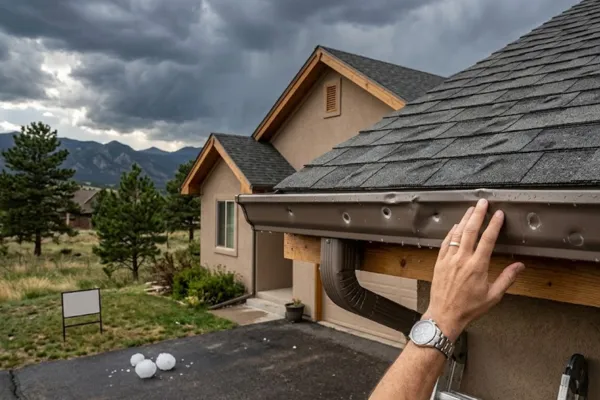
Hail Season Is Not Over
And for Some Front Range Homeowners, the Claim Clock Is About to Run Out
Most Coloradans think of hail as a June problem. That is where the worst of it usually lands, but the season runs from roughly April into September, and August storms are neither rare nor gentle. If you are on the Front Range, your roof is still exposed for another six to eight weeks.
That is the forward-looking half of this article. The urgent half is about storms that already happened.
Time-sensitive: check your calendar
Most Colorado homeowner policies allow roughly one year from the date of loss to file a hail claim. Some allow as little as six months. That means the filing windows for last summer's Front Range storms are expiring right now — through July and August 2026.
The 2026 season has already produced at least two significant Front Range hail events: June 1 and June 24. If either of those storms passed over your address, your clock started that day.
If you have been putting off an inspection, this is the month it stops being optional.
The 2026 Season So Far
On Monday, June 1, the first major hail storm of the season moved across the Front Range. Storms built quickly along the I-25 corridor in the early afternoon, worked over the Denver metro, then a second round of cells hit the Colorado Springs area before the whole system pushed out onto the eastern plains by evening. A second notable event followed on June 24.
The thing about storms like these is how quietly they do damage. Roofers who have worked Colorado for decades will tell you the same thing: a single event damages thousands of roofs whose owners will not find out until a leak appears months later — sometimes after the filing window has closed.
The Two Deadlines That Matter, and Why People Miss Them
There are two separate clocks, and homeowners routinely confuse them. Colorado law gives you a relatively long statutory window to bring a claim dispute. Your insurance policy gives you a much shorter one to report the loss in the first place. The practical takeaway is simple: the policy deadline almost always expires well before the statute does, and it is the policy deadline that will get your claim denied.
Because Front Range hail is frequent, there may also be several qualifying storm dates within a single year. Which date you file under can matter, and an experienced inspector will help you identify the right one against NOAA storm records for your ZIP code.
Order of Operations — This Is Where Most Homeowners Go Wrong
The single most common mistake is calling the insurance carrier first. It feels like the responsible move. It often is not.
When you call to report possible hail damage, many insurers open a claim on your record immediately — even if an adjuster later finds too little damage to justify a payout. A claim that closes with no money paid can still follow you and push up your future premiums. In a state where premiums have already risen sharply, that is not a trivial cost.
Get an independent inspection first. Find out whether you have real, documentable damage. Then decide whether to file.
What to Document, and How
•Write down the exact date. Claims attach to a specific date of loss. Having it recorded from day one makes everything downstream smoother.
•Pull the NOAA storm record for your ZIP code. Your carrier will reference it. You should know what it says before they do.
•Photograph from the ground — do not climb. Wet or hail-bruised shingles are genuinely dangerous, and you do not need roof-level photos to open a file.
•Look well beyond the roof. Adjusters review the full exterior: siding, gutters, downspouts, window screens, garage door, air conditioner condenser fins, soft metal vents, decking, fencing, and landscaping. Soft metals almost always carry visible evidence of a real hail event, which is why they matter so much to a claim.
•Save a hailstone if you can. Photograph it next to a ruler or a coin. Size documentation is powerful, and it is the one piece of evidence that disappears within the hour.
•Know what an adjuster looks for on the roof itself. Bruising and granule loss are the clearest indicators, particularly on three-tab shingles.
Read Your Policy Before the Storm, Not After
Two provisions decide most of what happens next, and most homeowners have never looked at either one.
Replacement cost versus actual cash value. A replacement cost policy pays to replace your roof with comparable materials at current prices, less your deductible. An actual cash value policy pays the depreciated value. On an older roof, that gap can run into many thousands of dollars that come out of your pocket.
Your wind and hail deductible. It is frequently separate from your standard deductible and is often expressed as a percentage of your dwelling coverage rather than a flat dollar amount, commonly in the one to five percent range. On a $585,000 home, the difference between a $2,500 flat deductible and a two percent hail deductible is substantial.
If you are having genuine difficulty finding coverage because of hail exposure, the Colorado FAIR Plan exists as a backstop and provides basic property coverage. It generally pays on an actual cash value basis, with optional endorsements available for wind and hail. It is a safety net rather than a first choice, but it is there.
The Real Estate Angle
Roof condition is one of the highest-consequence items in any Front Range inspection. When a buyer's inspector finds hail damage that the seller did not know about, the transaction almost always changes shape: a credit request, a price reduction, a repair demand, or a termination.
If you are thinking about listing in the next twelve months, get the roof inspected now, on your timeline, while you still have a filing window open. Resolving a hail claim before you list is straightforward. Resolving one during a contract, against a deadline, with a nervous buyer watching, is not.
And if you have already replaced a roof under a claim, keep the documentation. A recent, permitted roof with paperwork is a legitimate selling point in a market where buyers are scrutinizing carrying costs and insurability more than they have in years.
Bottom Line
Hail is the most reliably underestimated risk in Colorado homeownership. The storms of June 1 and June 24 are already on the record, and the filing windows for last summer's events are closing this month. Get an independent inspection before you call your carrier, know whether your policy pays replacement cost or depreciated value, and find out what your hail deductible actually is. Thirty minutes of reading your policy this month is worth more than any amount of hoping.

