Robots Are Building Houston’s Newest Houses?
Imagine a construction site where the "builder" never gets tired, never takes a lunch break, and can print a wall in a matter of minutes. It sounds like science fiction, but just 20 minutes south of downtown Houston, it is becoming a reality.
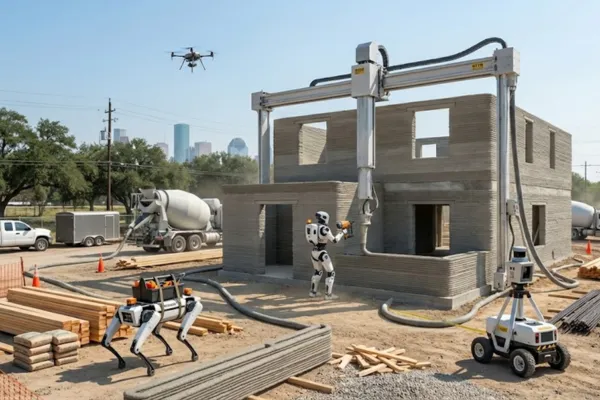
Zuri Gardens, a new 13-acre development off Highway 288, is set to become Houston’s first 3D-printed single-family community. While the site currently looks like a field of gravel, it will soon host 80 "forever homes" built by a massive robotic arm.
Here is what you need to know about this groundbreaking project and why it might change the way we think about homeownership.
A "Hybrid" Home Building Approach
Zuri Gardens isn't fully replacing human workers with machines—it's teaming them up. The project uses a hybrid model:
The Robot: A robotic arm, operated by technology partner HiveAsmbld, prints the entire first floor using a proprietary cement mix. This shell creates the structural foundation of the home.
The Humans: Once the concrete cures (which happens in minutes thanks to a special eco-friendly mix), traditional human framers take over to build the second floor using standard "stick building" methods.
The result is a Modern Farmhouse style home spanning roughly 1,360 square feet, complete with two bedrooms, 2.5 bathrooms, an office, and a covered patio.
Why Print a House?
You might be asking, "Why use a robot?" The answer lies in three key benefits: Resilience, Speed, and Cost.
1. Flood-Proof Living
For Houstonians, the threat of flooding is a constant anxiety. These 3D-printed homes offer a unique solution. Because the first floor is made entirely of concrete (no sheetrock, no wood studs), it is essentially waterproof.
According to developer Vanessa Cole, if a flood happens, homeowners can simply "wipe down the walls." The electrical and plumbing are encased within the concrete shell, protecting them from water damage. It’s a level of durability that traditional wood-frame houses just can't match.
2. Unbeatable Durability
The cement used at Zuri Gardens is incredibly strong—rated at 6,500 PSI, which is significantly harder than the concrete used for city streets. HiveAsmbld co-founder Tim Lankau calls them "forever houses," noting that they are impervious to termites, rot, mold, and severe storms.
3. True Affordability
Perhaps the most exciting aspect is the price tag. Thanks to the efficiency of the technology and city funding, these homes are expected to sell in the mid-to-high $200,000s—roughly $100,000 less than the national median home price.
Additionally, eligible buyers (those making less than 120% of the area median income) may qualify for up to $125,000 in down payment assistance, making homeownership accessible to many who have been priced out of the market.
Is There a Catch?
While the benefits are massive, the "indestructible" nature of the homes does come with one trade-off: Renovations are difficult.
Because the walls are solid concrete, you can't easily knock down a wall to open up the floor plan later. However, you can still paint, plaster, and hang art just like you would on a normal wall.
The Bottom Line
Zuri Gardens represents a major leap forward for construction technology. By combining the precision of robotics with the necessity of affordable, flood-resistant housing, this project proves that the home of the future isn't just a concept—it's already being printed

