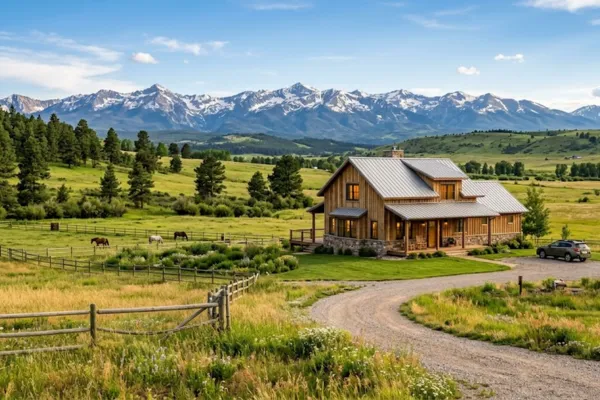
Zero Down Outside Denver: The Complete Guide to USDA Loans
If you’re looking to buy a home just outside the Denver metro area, you might be sitting on one of the best-kept secrets in real estate financing: the USDA Section 502 Guaranteed Rural Housing Loan.
While the name suggests farmland and tractors, the USDA loan program is actually designed to promote homeownership in rural and semi-rural areas. In Colorado, that definition is incredibly generous. For a properly qualified buyer, this program offers a genuine zero-down-payment option, putting it in the same league as VA loans for affordability, without the military service requirement.
Here is a breakdown of why a USDA loan might be the perfect fit for your next move.
Why Choose a USDA Loan?
The USDA doesn't lend directly; instead, they back the loan with a 90% guarantee to a traditional, USDA-approved lender. This guarantee allows lenders to offer incredibly competitive terms:
Zero Down Payment: You can finance 100% of the home's purchase price.
Lower Fees: USDA loans carry a 1.00% upfront guarantee fee (which you can roll into the loan amount) and a 0.35% annual fee based on the remaining principal. This is often significantly cheaper than FHA mortgage insurance or Private Mortgage Insurance (PMI) on a conventional loan.
Competitive Rates: Interest rates often run slightly below conventional market rates.
Predictability: All USDA loans are 30-year fixed-rate mortgages. There are no adjustable-rate surprises down the road.
Key insight: The upfront guarantee fee can be rolled into your loan, meaning you truly can get to the closing table with minimal out-of-pocket cash.
Do You Qualify? The Two-Part Test
Eligibility for a USDA loan is uniquely split into two categories: the borrower and the property.
1. Borrower Eligibility
Because the program is designed for low-to-moderate-income families, there are strict income limits.
Income Limits: Your total household income cannot exceed 115% of the area median income. For most areas in Colorado (including many counties outside Denver) for 2026, the limit is $122,800 for a 1-4 person household and $162,100 for a 5-8 person household. (Note: Certain high-cost areas like Boulder or the immediate Denver MSA have higher limits).
Credit Score: Most lenders look for a credit score around 640 or higher.
Debt-to-Income (DTI): The standard guidelines are 29% front-end (housing costs) and 41% back-end (total debt). However, lenders have flexibility if you have compensating factors like a high credit score or strong savings.
Use: The property must be your primary residence. No investment properties or income-producing farms allowed.
2. Property Eligibility
This is where the "rural" label surprises people. The USDA generally defines rural as anywhere with a population under 35,000 or areas considered "rural in character."
Property Types: Detached homes, townhomes, condos, Planned Unit Developments (PUDs), and even eligible manufactured homes can qualify.
The Colorado Map: Roughly 97% of Colorado's land area is eligible for USDA financing! While the dense Denver metro core is excluded, the surrounding suburban/exurban ring, the eastern plains, Weld County, and many mountain-adjacent communities are well within the eligible zones.
Because eligibility is determined by the exact address, not just the county, it’s crucial to run any potential listing through the USDA's eligibility map before making an offer.
Frequently Asked Questions
Can I buy a farm with a USDA loan?
No. Despite the name, Section 502 loans are for residential properties only. You cannot buy a working farm or an income-producing property with this program.
Can I use a USDA loan to build a home?
Yes! The USDA program allows eligible applicants to build, rehabilitate, improve, or relocate a dwelling, as well as purchase existing homes.
What happens if my income goes up after I buy the house?
The income limits only apply at the time of closing. If your income increases later, it will not affect your loan status or require you to refinance.

